

Well Child Tamariki Ora FHIR Implementation Guide
0.1.0 - release

Well Child Tamariki Ora FHIR Implementation Guide
0.1.0 - release
Well Child Tamariki Ora FHIR Implementation Guide - Local Development build (v0.1.0) built by the FHIR (HL7® FHIR® Standard) Build Tools. See the Directory of published versions
The following diagram provides a conceptual overview of the WCTO and B4SC FHIR resources, clinical information domains, authorship, and workflow lifecycle.
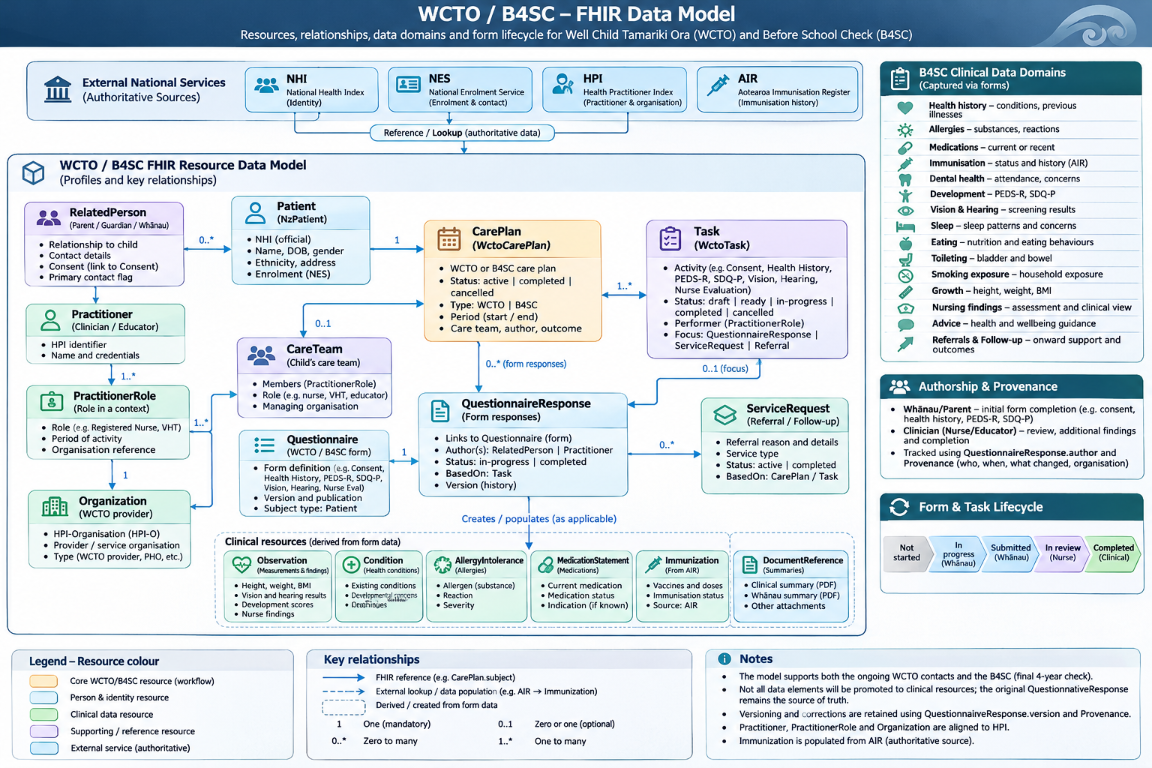
Note: This is a conceptual illustration. The detailed FHIR resource relationships and cardinalities are defined in the technical data model.
Status: Draft design. This page describes candidate FHIR relationships, not a published conformance requirement. Confirm profile definitions, references, and cardinalities against the IG's FSH and the selected FHIR version.
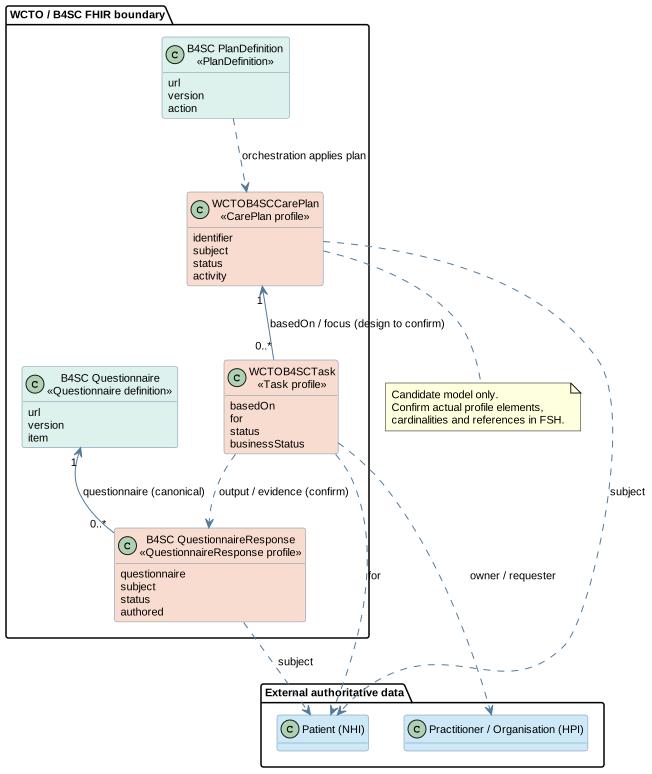
The following focused diagram complements the overview above. Its editable source is diagrams/fhir-data-model.puml. The detailed proposed relationships and cardinalities are shown in the B4SC FHIR data model.
| Topic | Correct modelling approach |
|---|---|
| CarePlan and Task | Use Task.basedOn to reference the B4SC CarePlan where this workflow design is adopted. Do not claim CarePlan.activity directly references a Task. |
| PlanDefinition | A reusable workflow definition is interpreted by orchestration logic to create CarePlan/Tasks. A diagram arrow is not an automatic FHIR reference. |
| QuestionnaireResponse and Observation | Observation creation is a conditional extraction/transformation, not an automatic reference from QuestionnaireResponse. |
| QuestionnaireResponse version | There is no QuestionnaireResponse.version element. meta.versionId is server-managed; the Questionnaire canonical can be versioned independently. |
| Task state | Task.status must use FHIR-defined status codes. More detailed service stages may use Task.businessStatus and workflow rules. |
| Clinical completion | QuestionnaireResponse.status=completed means the response is completed, not that B4SC has been clinically signed off. |
| Authorship | Use QuestionnaireResponse.author/source as appropriate, and a reviewed provenance/version strategy for multiple contributions. |
| Immunisation | AIR is authoritative; WCTO should not imply it creates source immunisation records. |
| Cardinalities | Do not invent 1..1 or 0..* profile constraints without FSH and clinical agreement. |
| Resource | Responsibility |
|---|---|
| Patient | Child identity, NHI identifier, demographics sourced under authorised arrangements |
| RelatedPerson | Parent, guardian, whānau relationship to child, where represented |
| Practitioner / PractitionerRole / Organization | Provider identity, professional role and organisation; HPI is authoritative where applicable |
| CarePlan | One B4SC CarePlan per child for this use case, checked by the orchestration service |
| Task | Work items, ownership, business status, completion and follow-up |
| Questionnaire / QuestionnaireResponse | Versioned form definitions and captured answers |
| Provenance | Record contribution/review/amendment history where adopted |
| Observation | Selected measured or clinically validated findings |
| Condition / AllergyIntolerance / MedicationStatement | Candidate clinical records only after agreed reconciliation |
| Immunization | AIR-sourced immunisation information |
| ServiceRequest | Referral intent if adopted; not necessarily an electronic referral system |
| DocumentReference / Composition | Generated summaries and structured documents where adopted |