

Well Child Tamariki Ora FHIR Implementation Guide
0.1.0 - release

Well Child Tamariki Ora FHIR Implementation Guide
0.1.0 - release
Well Child Tamariki Ora FHIR Implementation Guide - Local Development build (v0.1.0) built by the FHIR (HL7® FHIR® Standard) Build Tools. See the Directory of published versions
Draft security and source model. This page documents proposed boundaries; implementation requires privacy, access-control and clinical approvals.
| Data | Candidate authoritative source | Notes |
|---|---|---|
| NHI, demographic identity | NHI | Authorised lookup only |
| GP enrolment | NES | Confirm actual available fields |
| Practitioner, role, organisation | HPI | Maintain separate identity and role references |
| Immunisation | AIR | Source system remains authoritative |
| Existing clinical history | PMS/EMR | Subject to integration, permissions and data provenance |
| B4SC workflow state | WCTO scheduler / FHIR workflow | CarePlan and Task business rules |
| Previous form responses | WCTO form store | Access to prior submissions must be authorised |
This source diagram is a draft reference, not an approved interface or security specification.
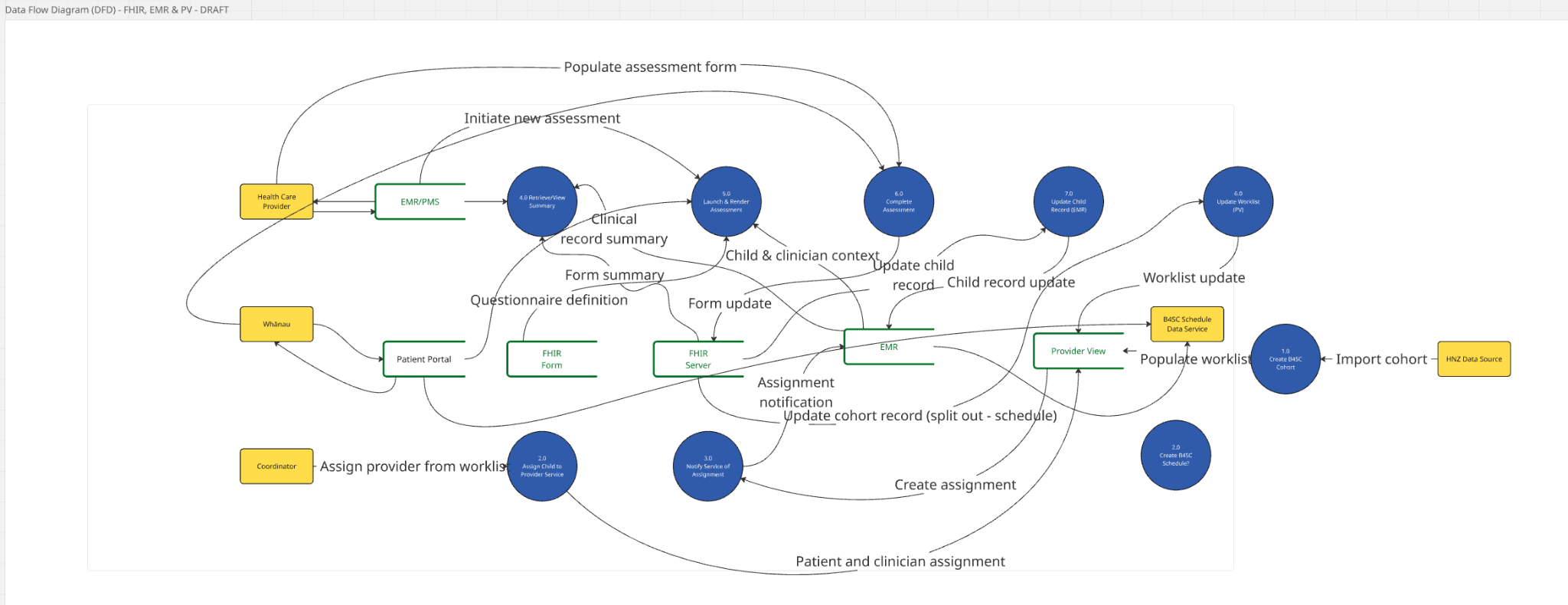
Confirm the exact source and access decision for each field; capture provenance for prepopulated values; apply least-privilege access; protect generated summaries; and audit retrieval, amendment and publication.