

Well Child Tamariki Ora FHIR Implementation Guide
0.1.0 - release

Well Child Tamariki Ora FHIR Implementation Guide
0.1.0 - release
Well Child Tamariki Ora FHIR Implementation Guide - Local Development build (v0.1.0) built by the FHIR (HL7® FHIR® Standard) Build Tools. See the Directory of published versions
This page explains how WCTO components fit together and directs implementers to the single authoritative definition for each technical detail. Element cardinalities and FHIR constraints are maintained in Profiles, not repeated here.
| Principle | Application to WCTO |
|---|---|
| Reuse national services | Query approved national services rather than creating competing identity, enrolment or immunisation stores |
| Reference rather than replicate | Persist only the information required for WCTO workflow and approved reporting |
| Capture once | Reuse assessment evidence appropriately across authorised workflow steps |
| Separate forms from workflow | QuestionnaireResponses capture answers; CarePlan and Task coordinate work |
| Preserve authorship | Distinguish whānau, educator and clinician contributions |
| Support staged completion | Forms and screening may progress independently; nurse evaluation is the final clinical gate |
| Minimise disclosure | Access and link security must be defined and reviewed; a link alone must not be treated as proof of identity |
| Use FHIR appropriately | Reuse base and NZ profiles where suitable, constrain only where required |
| Respect licensed content | Confirm permission before publishing copyrighted questionnaires or scoring content |
| Manage versions | Version templates, forms and implementation contracts deliberately |
The Scheduler coordinates CarePlan and Task creation or reuse; the Schedule API exposes information to consumers. The Coordinator application supports staff workflow, while PMS/EMR systems may consume schedule information and request form launches. The final deployment topology and service interfaces remain to be confirmed.
The B4SC CarePlan coordinates the child's check. It is not created from a QuestionnaireResponse. Tasks represent work; responses record answers and may supply evidence for completion. Solid arrows below represent intended references; dashed arrows represent proposed orchestration or evidence associations, which require detailed mapping.
Read the FHIR Data Model for relationship explanations, Profiles for exact element definitions, Examples for resource instances and B4SC Workflow for completion rules.
The cohort source, nomination interface, authorised form launch design, service ownership and final closure events are not yet approved. These are tracked in Decisions and Tests.
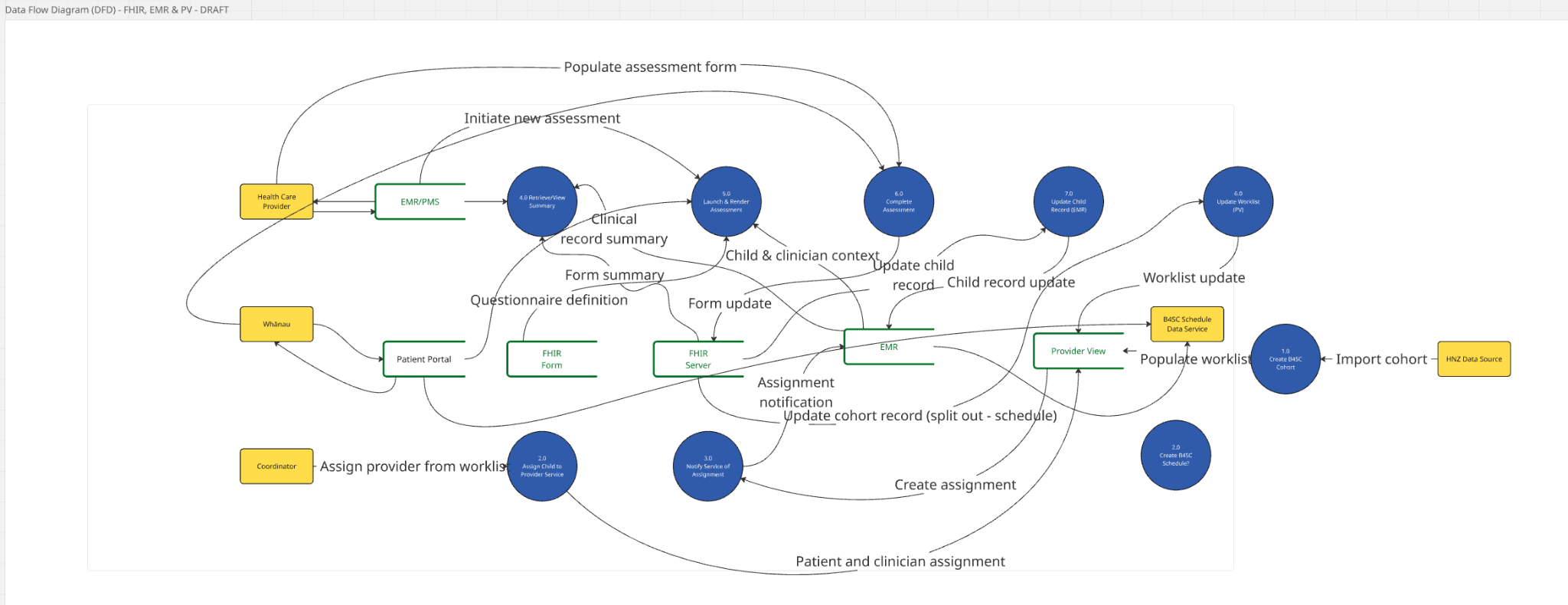
The following diagrams were provided as draft reference material. They illustrate existing thinking, not approved interface contracts. The FHIR model and orchestration rules documented in this guide take precedence where the diagrams omit CarePlan and Task details.
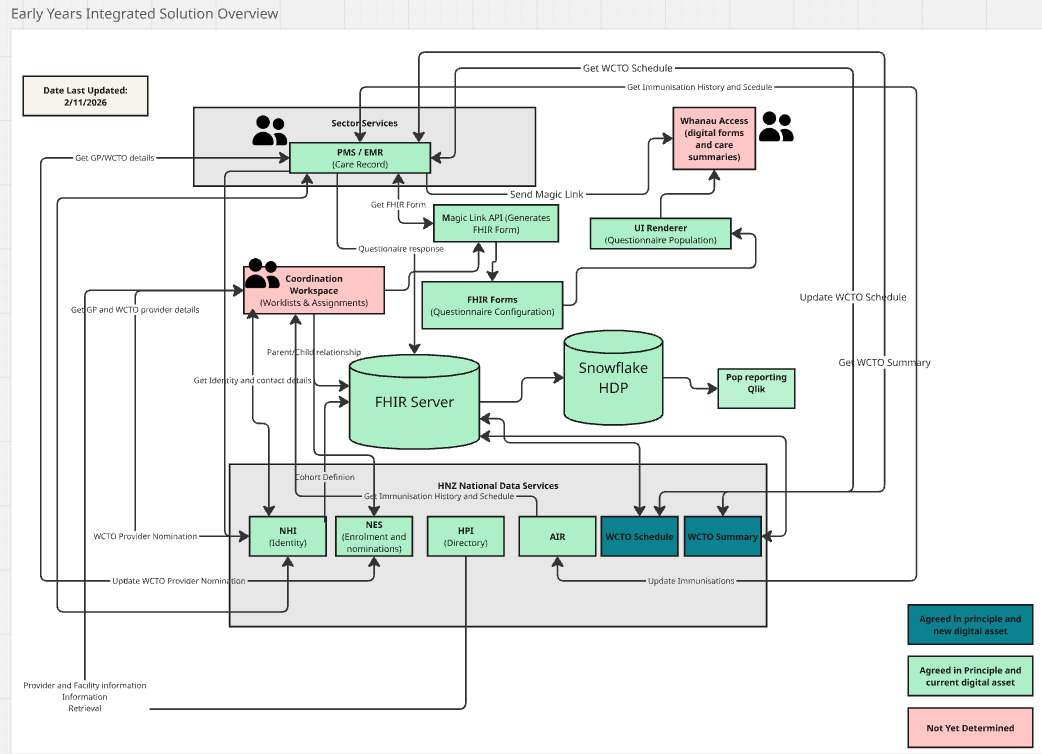
The integrated view includes PMS/EMR, coordination workspace, Magic Link, renderer, FHIR Server, NHI, NES, HPI, AIR, WCTO Schedule, WCTO Summary, and downstream Snowflake/HDP reporting. Reporting is not the operational source of Task status.